The Ultimate Brew Ratio Guide: Unlock Perfect Coffee, Every Time

The Secret Weapon: Why Your Coffee’s Brew Ratio Matters
The brew ratio is the precise relationship between the weight of your dry coffee grounds and the weight of the water (or liquid espresso) used to brew. It’s the foundational setting that dictates your coffee’s strength, body, and overall flavor balance.
Ever poured a cup that felt utterly perfect—vibrant, nuanced, and wonderfully balanced—only to have the next one taste dull, watery, or even aggressively bitter? The difference often isn’t just your beans or grinder; it’s the coffee extraction ratio, your most powerful lever for flavor control. Mastering this seemingly simple concept unlocks unparalleled consistency, allowing you to manipulate taste with precision and turn every good coffee experience into a truly great one. Ready to transform your home brewing journey? Let’s dive in!
Before we dial in ratios, ensure you’ve got the basics down. Our Beginner’s Guide to Coffee Brewing: Essential Concepts Beyond Ratio offers a perfect starting point for understanding grind size and water temperature.
Taste Unpacked: The Science of Coffee Extraction & Solubility
Extraction is the process where hot water dissolves flavorful compounds from coffee grounds. Think of your coffee grounds as tiny treasure chests, each holding a symphony of soluble components: sugars, acids, oils, and aromatics. Hot water acts as the key, unlocking and carrying these compounds into your cup.
Your goal is to extract the “sweet spot” – those delightful acids, complex sugars, and vibrant aromatics – while leaving behind the less desirable elements often associated with under-extraction or over-extraction.
- Under-extraction: Not enough soluble compounds have dissolved. Your coffee will often taste sour (like unripe fruit), thin, watery, and lack body, leaving a short, unsatisfying finish. It’s like only getting a faint whisper of the treasure.
- Over-extraction: Too many soluble compounds, especially bitter and astringent ones, have dissolved. This results in coffee that tastes bitter (like burnt toast), harsh, hollow, and often leaves a drying, astringent mouthfeel. Imagine digging too deep and hitting nothing but dry dirt.
While ratio is a crucial variable, it works in concert with grind size, water temperature, contact time, and turbulence. These elements collectively determine the total extraction and brewing time, profoundly shaping your final cup’s flavor profile.
Fascinated by what makes your coffee sing? Delve into the intricate world of flavor creation in The Chemistry of Coffee: A Deep Dive into Extraction and Flavor Compounds.
The Golden Compass: Navigating the SCA Golden Cup & Recommended Ratios
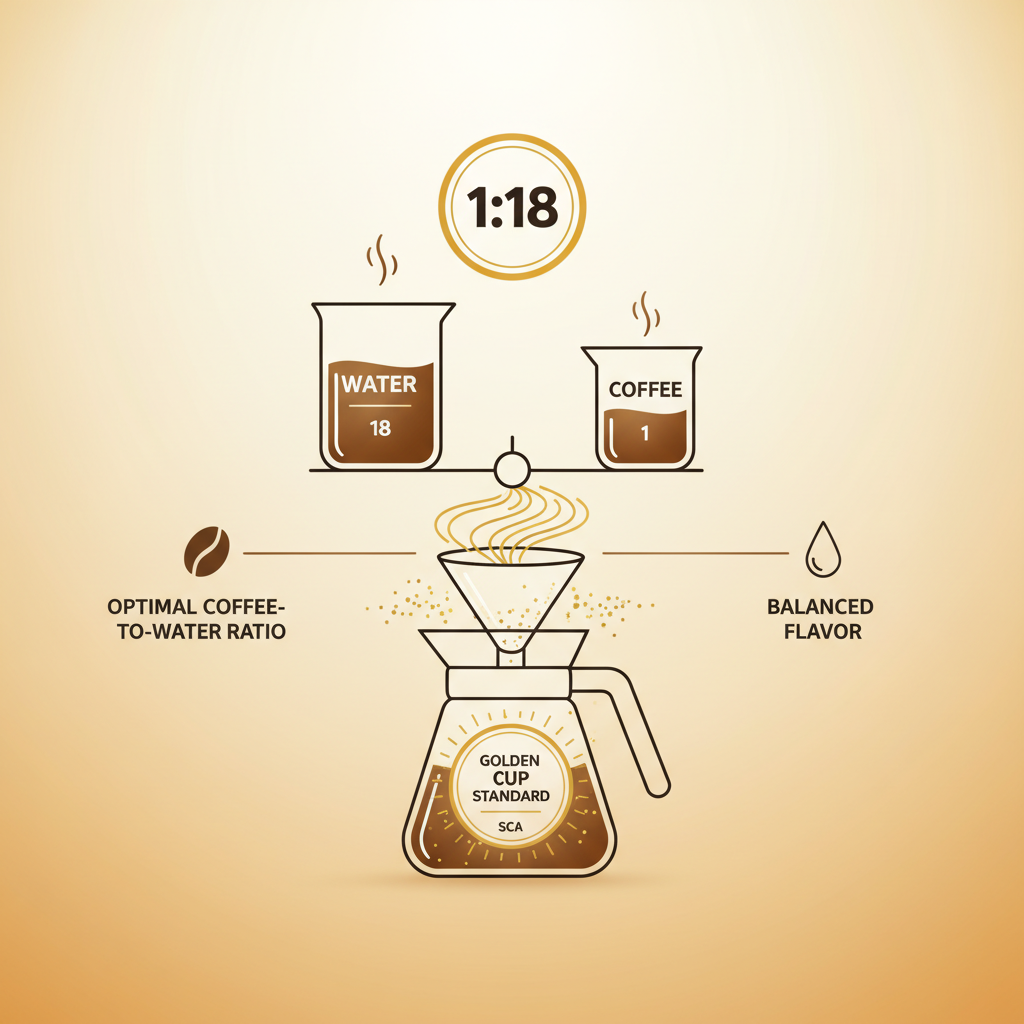
The SCA Golden Cup Standard is a benchmark established by the Specialty Coffee Association for optimal brewing, guiding brewers to achieve consistently delicious and balanced coffee.
For decades, the universally recognized ‘Golden Ratio’ for coffee, often championed by the SCA, has been 1:18 coffee to water. This means for every 1 gram of coffee, you’d use 18 grams of water. Another widely popular recommendation, especially for manual methods, is a 1:16 ratio. This 1:16 to 1:18 range is often considered the sweet spot for many methods like pour-over, French Press, and automatic drip, aiming for a harmonious balance of sweetness, acidity, and bitterness.
However, consider the Golden Ratio a sophisticated starting point, not an unbreakable law. It offers a high probability of a well-balanced brew, a dependable baseline for your experiments. The real art, which we’ll explore in ‘dialing in,’ comes from understanding how to adapt this benchmark to different brewing methods, roast levels, and, most importantly, your personal taste preferences.
- Pro Tip:
“Consistency is the unsung hero of great coffee. While the SCA Golden Cup Standard provides an excellent starting point, a truly expert barista understands that the ‘perfect’ ratio is the one that consistently tastes best to you with your specific beans and equipment. Don’t be afraid to deviate slightly once you’ve established a baseline.” – Insight from a Q-Grader’s best practices.
Curious about the SCA’s vision for the perfect cup? Our detailed guide on the SCA Golden Cup Standard Explained: Achieving Professional Brew Quality at Home will help you achieve professional-grade results at home.
Precision in Practice: Accurate Measurement & Calculating Ratios
Achieving consistent, delicious coffee demands precision. Just as a baker meticulously measures ingredients, a dedicated home barista relies on exact measurements. Your single most vital tool for consistent ratios is a digital scale that measures in grams. This allows you to accurately track the weight of coffee grounds and the weight of water used.
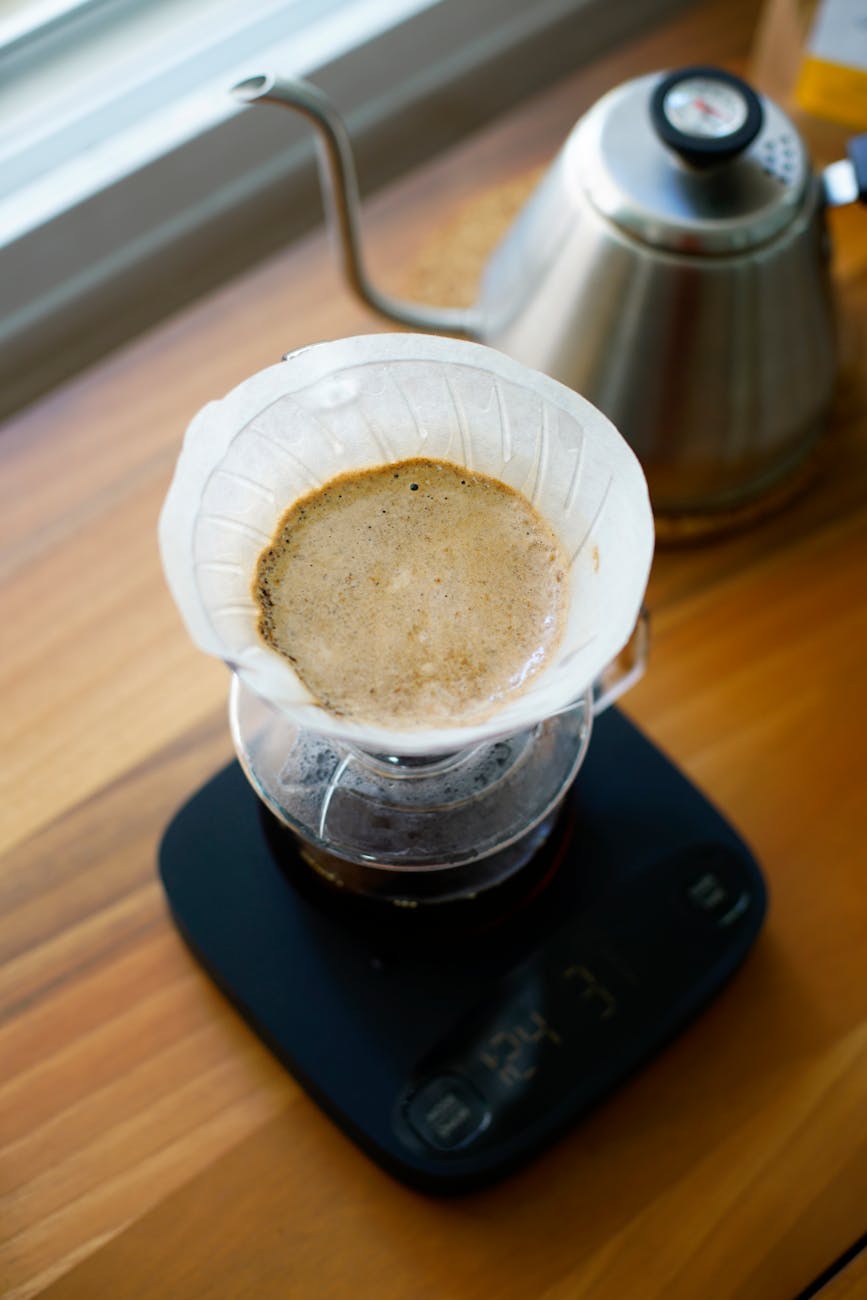
Here’s how to calculate your coffee-to-water ratio for any batch size:
- Define your desired water weight: Decide how much brewed coffee you want (e.g., 300g for a standard mug).
- Select your target ratio: Let’s use 1:16 as our example.
- Calculate coffee grounds needed: Divide your desired water weight by the “water” portion of your ratio (e.g., 300g water / 16 = 18.75g coffee). Round this to a practical number, like 19g.
- Calculate water needed: Multiply your coffee grounds weight by the “water” portion of your ratio (e.g., 19g coffee * 16 = 304g water).
This straightforward calculation allows you to scale up or down your brew effortlessly. Whether it’s a quick single cup or a carafe for guests, you’ll maintain your desired brew ratio and, crucially, your preferred flavor profile.
Practical Examples: Scaling for Different Batch Sizes (using 1:16 ratio)
| Desired Brewed Coffee (Water Weight) | Calculation (Water / 16) | Coffee Grounds Needed |
|---|---|---|
| 200g (Small Batch) | 200g / 16 | 12.5g |
| 300g (Standard Mug) | 300g / 16 | 18.75g (approx. 19g) |
| 400g (Medium Batch) | 400g / 16 | 25g |
| 600g (Large Batch) | 600g / 16 | 37.5g |
Ready to equip your coffee corner for consistent excellence? Explore our recommendations for the Essential Coffee Brewing Tools: Scales, Grinders, and Timers for Precision.
Mastering Manual Brew Ratios: Pour-Over, French Press & More
Manual brewing methods offer intimate control over the brewing process, but each method’s unique dynamics demand subtle ratio adjustments to unlock peak flavor.
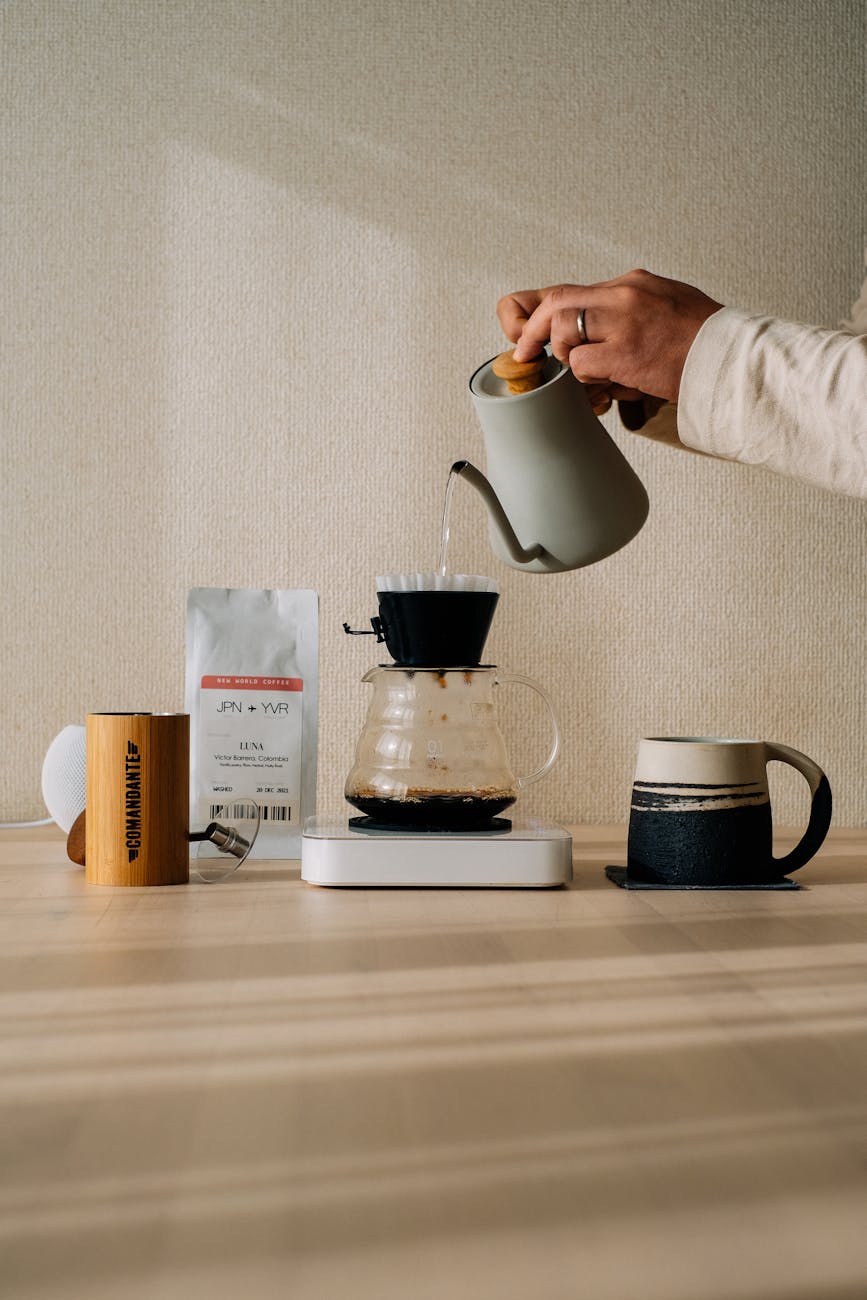
Pour-Over Coffee Ratios
For methods like the Hario V60, Chemex, or Kalita Wave, a pour-over coffee ratio between 1:15 to 1:17 is typically recommended. The constant flow of fresh water through a filter, combined with a relatively short contact time, means you’re aiming for efficient extraction without over-saturating the grounds.
- Why this range? Pour-over’s continuous percolation and filtration tend to produce a cleaner cup. A slightly tighter ratio (e.g., 1:15) can enhance the body and intensity for lighter roasts, while a looser ratio (1:17) might prevent bitterness in darker roasts where compounds extract more readily.
French Press Ratios
The French Press, beloved for its full-bodied and robust brews, employs an immersion method where coffee grounds steep entirely in water. Due to the longer contact time and retention of fines, a bolder ratio is often favored, typically ranging from 1:12 to 1:15.
- Why this range? The complete immersion ensures maximum saturation. A 1:12 ratio will yield a very strong, rich cup, while 1:15 provides a more balanced yet still characteristically full-bodied experience. The coarse grind and longer steep inherently extract more, so less water per gram of coffee still yields significant flavor.
Other Manual Methods & Their Ratios
- AeroPress: Exceptionally versatile, the AeroPress can brew concentrated shots or full-bodied coffee. For concentrated brews meant for dilution (often inverted), ratios frequently range from 1:10 to 1:15. For a more standard, ready-to-drink cup, a 1:16 ratio with a slightly longer steep also works wonderfully. The ability to use pressure for extraction adds another dimension.
- Siphon: Visually captivating, the Siphon, with its unique vacuum brewing process, typically performs well with ratios around 1:12 to 1:15, similar to French Press, yielding a clean yet deeply flavored cup.
Impact of Ratio on Manual Brew Characteristics
- Strength: A lower second number (e.g., 1:14 vs. 1:16) means more coffee per gram of water, resulting in a stronger, more intense brew.
- Body: Tighter ratios can often enhance body and mouthfeel, but push too far, and you might encounter an undesirable gritty or drying astringency.
- Clarity: While grind size and filter type primarily dictate clarity, an optimized ratio ensures you’re extracting the most pleasant soluble compounds, contributing to a clean, harmonious finish.
For a complete guide to perfecting your pour-over, including detailed ratio recommendations and step-by-step techniques, explore our Ultimate Guide to Pour-Over Brewing: Techniques, Ratios, and Equipment.
Espresso Brew Ratios: A Deep Dive into Precision Shots
Espresso operates on a fundamentally different principle than other brewing methods. Instead of a full cup, the goal is a concentrated, intense shot. This means espresso brew ratios are significantly tighter and more focused on the relationship between dry coffee grounds (dose) and liquid espresso in your cup (yield). We’re talking about extremely fine grinds, high pressure, and very short contact times.
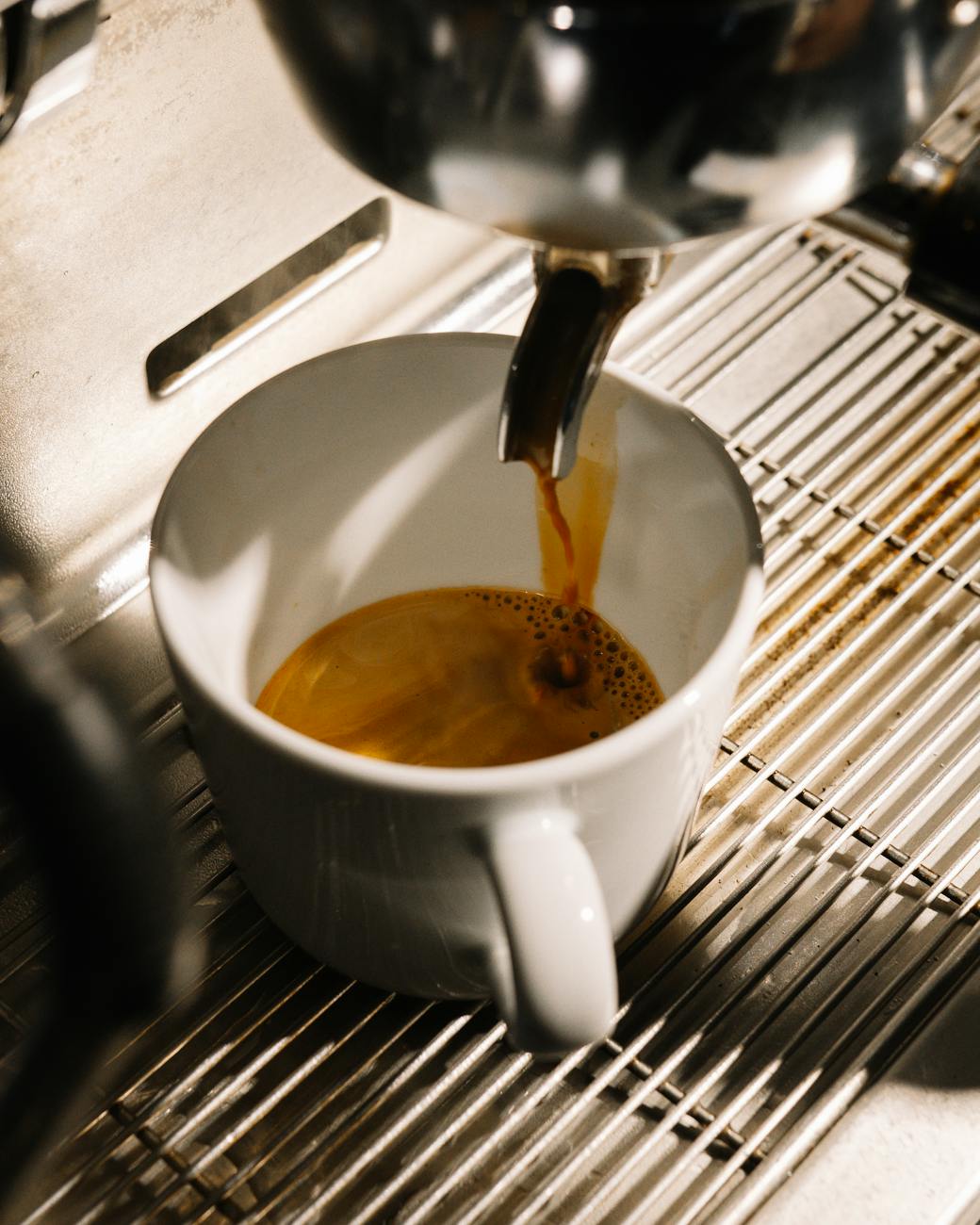
Espresso ratios are always expressed as dry coffee dose (grams) to liquid espresso yield (grams).
Common Espresso Shot Ratios
- Ristretto (1:1 – 1:1.5): A very short, highly concentrated shot. For a 20g dose, you’d aim for 20-30g of liquid espresso. Ristrettos are typically intense, sweet, and viscous, often with reduced bitterness due to less overall extraction.
- Normal / Normale (1:2 – 1:2.5): This is the most common and versatile ratio for a balanced espresso. A 20g dose would yield 40-50g of liquid espresso. This ratio balances sweetness, acidity, and bitterness, making it ideal for standalone shots or as the base for lattes and cappuccinos.
- Lungo (1:3 – 1:4): A “long” shot with more liquid espresso weight. A 20g dose might yield 60-80g of espresso. While not universally preferred, lungos can accentuate different characteristics, often highlighting more bitterness and less body, but can reveal nuanced flavors in some lighter roasts.
Understanding Espresso Yield: Measuring Liquid Espresso Weight
For espresso, measuring liquid espresso weight is paramount, not volume. The crema, while beautiful, can deceptively add volume without contributing significant coffee solids. Always place your demitasse cup on a digital scale during extraction to precisely measure the amount of espresso in grams. This is your key to consistent dialing in.
Impact of Ratio on Espresso Flavor
- Acidity: Shorter ratios (ristrettos) often emphasize bright, vivid front-end acidity.
- Sweetness: The 1:2 to 1:2.5 range frequently hits the “sweet spot” for optimal sugar development and balance.
- Bitterness: Longer ratios (lungos) tend to extract more bitter compounds, especially if extending extraction time significantly.
- Body: Ristrettos and normal shots typically boast a richer, more viscous, and luxurious body.
Ready to pull café-quality espresso shots at home? Our comprehensive guide to espresso shot ratios and extraction will walk you through every detail in Espresso Mastery: A Comprehensive Guide to Shot Ratios and Extraction.
The Art of ‘Dialing In’: Adjusting for Personalized Perfection
‘Dialing in’ is the systematic process of adjusting brewing variables to achieve your desired taste profile. It’s an ongoing conversation between your brewing method and your palate. Think of yourself as a coffee scientist, making small, deliberate changes and observing the results until you strike gold.

How to Evaluate Your Brew with Precision
Every adjustment begins and ends with sensory evaluation. When tasting, pay close attention to:
- Balance: Do the flavors harmonize, or does one aggressively dominate?
- Sweetness: Is there a pleasant, lingering sweetness, like caramel or ripe fruit?
- Acidity: Is it bright and lively (like citrus) or sharp and unpleasantly sour (like vinegar)?
- Bitterness: Is it pleasant and complex (like dark chocolate) or harsh and drying?
- Body/Mouthfeel: Is it thin and watery, medium and silky, or full and syrupy?
- Aftertaste: How does the flavor linger? Is it clean and pleasant, or does it leave an undesirable residue?
Practical Workflow for Ratio Adjustment
- Start with a Benchmark: For most manual brews, begin with a 1:16 ratio. For espresso, a 1:2 ratio is an excellent baseline. This gives you a known, generally well-balanced starting point.
- Brew and Taste: Prepare your coffee, allow it to cool slightly to reveal its full flavor spectrum, and taste it critically.
- Diagnose Flavor Defects:
- If it’s sour, weak, or watery: You’re likely under-extracted.
- If it’s bitter, harsh, or hollow with a dry finish: You’re likely over-extracted.
- Tweak One Variable at a Time: This is crucial, like tuning a musical instrument – adjust only one “string” at a time to hear its impact.
- Under-extracted (sour, weak): Try a tighter ratio (less water per gram of coffee). For example, if you were at 1:16, try 1:15. This increases the concentration of dissolved solubles and helps extract more. Alternatively, consider a finer grind or hotter water to increase extraction efficiency.
- Over-extracted (bitter, harsh): Try a looser ratio (more water per gram of coffee). If you were at 1:16, try 1:17. This effectively dilutes the extracted solubles. Alternatively, consider a coarser grind or slightly cooler water to decrease extraction.
- Repeat, Taste, Refine: Continue brewing, tasting, and making incremental adjustments until your cup reaches personalized perfection. Keep a logbook of your experiments!
Troubleshooting Common Issues with Ratio Adjustments
- Too Strong / Too Weak: Your ratio is the primary adjustment here. For stronger coffee, use less water (e.g., 1:15). For weaker coffee, use more water (e.g., 1:17).
- Sour / Under-extracted: A tighter ratio can help, but if the issue persists, a finer grind or hotter water are powerful levers to increase extraction.
- Bitter / Over-extracted: A looser ratio can mitigate bitterness. If it remains, a coarser grind or slightly cooler water can reduce over-extraction.
Remember, changing the ratio directly manipulates strength and body. Grind size and water temperature primarily influence extraction efficiency and speed.
Don’t let a bad cup ruin your morning! Our Coffee Brewing Troubleshooting: Fix Common Flavor Problems guide offers expert solutions for fixing all sorts of flavor issues.
Advanced Control: Beyond the Ratio for Ultimate Flavor
True mastery of coffee brewing lies in understanding how your brew ratio interacts with every other variable. No single factor exists in isolation; they dance together to create your cup.
Grind Size vs. Ratio: A Dynamic Duo
Grind size is often your first variable to adjust. It dictates the coffee’s surface area exposed to water, profoundly impacting extraction speed and efficiency.
- Finer grind = faster, more efficient extraction (greater surface area).
- Coarser grind = slower, less efficient extraction (less surface area).
You’ll often start by adjusting grind size to hit your target brew time (e.g., 3:30 for pour-over, 25-30s for espresso). Once your brew time is in the sweet spot, then you can fine-tune the flavor profile by adjusting the ratio. For example, if your coffee tastes a bit weak at a fine grind and correct time, tightening the ratio can add intensity without drastically altering extraction dynamics.
Water Quality: The Unsung Hero of Coffee Extraction
You can have the perfect ratio and grind, but if your water is poor, your coffee will suffer. Water quality is arguably the most impactful yet overlooked variable. Water with too many dissolved minerals (hard water) can lead to over-extraction and scale buildup. Water with too few minerals (distilled or very soft water) can lead to under-extraction and a flat, muted taste. Aim for filtered water with a balanced mineral content (e.g., 100-150 ppm TDS or Total Dissolved Solids).
Roast Level & Bean Origin: Customizing Your Ratio
- Light Roasts: These beans are denser and harder to extract. They often benefit from a slightly tighter ratio (e.g., 1:15 for pour-over) and potentially higher water temperatures (93-96°C / 199-205°F) to ensure sufficient flavor extraction and body, allowing their complex fruit and floral notes to shine.
- Dark Roasts: More porous and easier to extract, dark roasts can quickly become bitter. A slightly looser ratio (e.g., 1:17) and potentially a slightly coarser grind or lower water temperature (88-92°C / 190-197°F) can help prevent over-extraction, preserving their rich chocolate and nutty notes without harshness.
- Bean Origin: Different origins boast varying densities and cellular structures. An Ethiopian Yirgacheffe might flourish at a slightly different ratio than a Sumatran Mandheling. Embrace experimentation to discover each bean’s ideal expression!
Temperature & Brewing Time: Sculpting Flavor Profiles
- Water Temperature: Generally, higher temperatures accelerate extraction efficiency, while lower temperatures slow it down. Experiment within the suggested ranges for your roast level to find optimal sweetness and acidity.
- Brewing Time: This is a direct consequence of your grind size, water flow, and contact method. Strive for consistency. If your brew time is too fast, your coffee will be under-extracted; if too slow, it will be over-extracted.
Understanding how different roast levels impact your brewing technique is crucial for unlocking the full potential of your beans. Learn more about matching your brewing to your roast in The Impact of Roast Level on Coffee Brewing Techniques and Ratios.
Frequently Asked Questions
Q: What is the “golden ratio” for coffee, and is it a strict rule?
A: The “golden ratio,” often recommended by the SCA, is typically 1:18 (1 part coffee to 18 parts water), though 1:16 is also a widely accepted standard. It’s an excellent, proven starting point designed to yield a balanced cup for most brewing methods. However, it’s not a strict rule. Think of it as a dependable guideline to begin your journey; your personal taste, the specific coffee beans (roast level, origin), and your brewing method will all influence your ideal ratio. Experimentation around this golden standard is highly encouraged!
Q: Why does my coffee taste sour or weak, even with good beans?
A: If your coffee tastes sour, weak, or watery, it’s a strong indicator of under-extraction. This means not enough of the desirable soluble compounds have been dissolved from the coffee grounds. To fix this, consider these adjustments, ideally one at a time:
- Tighten your brew ratio: Use less water per gram of coffee (e.g., go from 1:17 to 1:15).
- Grind finer: A finer grind increases surface area and extraction efficiency.
- Increase water temperature: Hotter water extracts more effectively (aim for 93-96°C/199-205°F).
- Increase contact time: For immersion methods, steep longer. For pour-over, ensure a steady, even pour and avoid very fast drawdowns.
Q: How do espresso brew ratios differ from regular coffee ratios?
A: Espresso brew ratios differ significantly because espresso is a highly concentrated shot, not a full cup. Regular coffee ratios typically range from 1:15 to 1:18 (coffee to water), aiming for a larger volume beverage. Espresso ratios are much tighter, often starting at 1:1 for a Ristretto, 1:2 to 1:2.5 for a Normale (standard espresso), and up to 1:3 or 1:4 for a Lungo. These ratios refer to the dry coffee grounds used (dose) to the liquid espresso yielded (output weight, not volume), not the total water added. The finer grind, high pressure, and short extraction time of espresso necessitate these different parameters to achieve its characteristic intensity and body.
Q: Should I adjust my ratio for different roast levels (light vs. dark)?
A: Yes, absolutely! Adjusting your ratio based on roast level is a fantastic way to optimize flavor:
- Light Roasts: These beans are denser and harder to extract. You might benefit from a slightly tighter ratio (e.g., 1:15) and potentially hotter water to ensure you extract enough of their complex acidity and sweetness.
- Dark Roasts: These beans are more porous and extract very easily. To avoid bitterness and over-extraction, you might prefer a slightly looser ratio (e.g., 1:17) and potentially a slightly coarser grind or lower water temperature.
Always taste and adjust based on your specific beans and preferences!
Conclusion: Your Journey to Ratio Mastery Begins Now
You’ve just equipped yourself with one of the most powerful tools in the home barista’s arsenal: the mastery of brew ratios. From understanding the scientific dance of extraction to precisely ‘dialing in’ for personalized perfection across every method, you now possess the knowledge to transform your daily cup.
But here’s the most exciting part: the journey has only just begun. Coffee brewing is a rewarding process of continuous discovery. With your digital scale as your trusted companion and this guide as your blueprint, embrace experimentation. Don’t be afraid to tweak, to taste, to learn, and to celebrate every nuanced flavor you uncover. The joy of consistently brewing coffee that’s not just good, but perfectly tailored to your unique palate, is what being a home barista is all about. Keep exploring, keep tasting, and above all, keep loving the process of crafting your perfect cup!