The Definitive Guide to Optimal Coffee Bean Storage: Master Freshness, Maximize Flavor, and Dispel Myths
Ever wondered why your meticulously chosen, freshly roasted coffee tastes amazing for a few days, then suddenly falls flat? You’re not alone. The internet is flooded with contradictory advice on coffee storage, leaving many curious brewers frustrated and unsure. Some advocate for the freezer, others vehemently oppose the fridge, and many just let beans sit in their original bags, hoping for the best.
This confusion directly impacts the complex flavors and enticing aromas you cherish in your daily cup. The truth is, proper coffee bean storage is one of the most impactful, yet often overlooked, factors in your brewing journey.
This guide cuts through the noise. Drawing on scientific insights and expert consensus from professional roasters and industry bodies like the National Coffee Association (NCA), we’ll equip you with practical, actionable strategies. Our goal? To empower you to maintain the peak freshness and maximize the flavor of your coffee beans for the longest possible time, ensuring consistently delicious coffee, every single day. Let’s solve the mystery of ‘the most effective way to store coffee beans.’
Understanding Coffee Freshness: What Makes Coffee Go Stale?
Coffee staleness refers to the degradation of a coffee bean’s desirable aromatic compounds and oils, leading to a dull, flat, or rancid taste. This process begins immediately after roasting, as delicate flavor components are exposed to the environment.
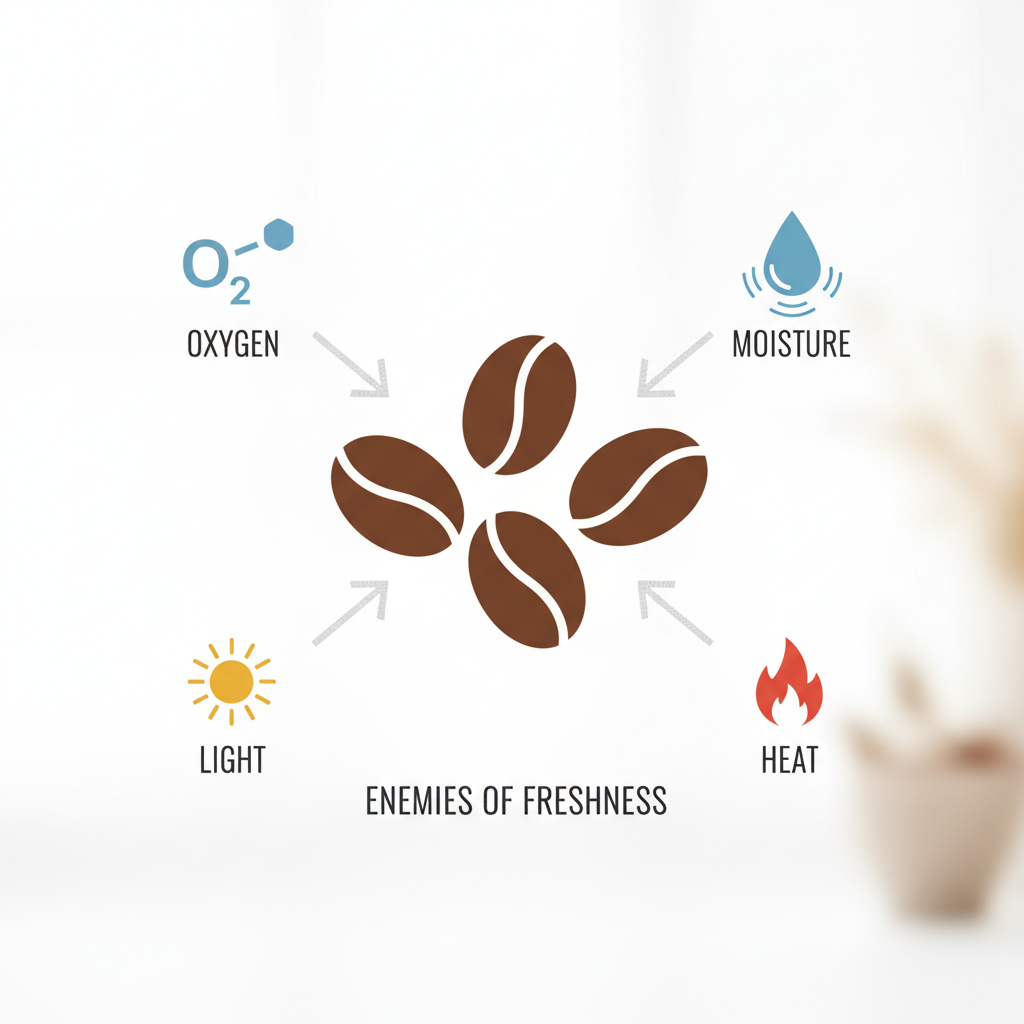
Roasted coffee beans are bustling factories of flavor, but they’re also highly volatile, constantly undergoing chemical changes. Understanding why they go stale is the first step to preventing it. Four primary antagonists accelerate this degradation: Oxygen, Moisture, Light, and Heat. We often refer to these as OMLH.
Oxygen (Oxidation)
Oxygen is arguably coffee’s most relentless foe. Once roasted, coffee beans release CO2 (a process called degassing) and simultaneously begin to absorb oxygen. This absorption initiates oxidation—a chemical reaction where oxygen molecules interact with the organic compounds in coffee, particularly the delicate lipids (fats) and volatile aromatic compounds. This process breaks down desirable flavors into less palatable ones, forming aldehydes and ketones that contribute to a “cardboard,” “rancid,” or “woody” taste. It strips coffee of its vibrancy, sweetness, and complexity.
Moisture
Coffee beans are hygroscopic, meaning they readily absorb moisture from their surroundings. Excess humidity or direct water contact accelerates detrimental chemical reactions, leading to flavor degradation and potential mold growth. Conversely, overly dry conditions can cause valuable volatile aromatics to dissipate faster. A stable, dry environment is essential to prevent both moisture absorption and excessive desiccation.
Light (UV Radiation)
Sunlight, particularly its ultraviolet (UV) radiation, is a powerful catalyst for coffee degradation. UV rays inject energy into the beans, speeding up the breakdown of delicate oils and aromatic compounds, similar to how they fade pigments. This is why coffee should always be protected in opaque containers or dark spaces.
Heat
Elevated temperatures dramatically accelerate all chemical reactions, including those that cause coffee to go stale. Think of it like cooking: heat transforms raw beans, but excessive heat after roasting quickly diminishes their desirable characteristics. Storing coffee in a warm environment, such as near a stove or in direct sunlight, significantly shortens its fresh lifespan, resulting in a flat, dull, and prematurely aged cup.
Understanding these enemies provides the scientific foundation for every optimal coffee storage practice. For a deeper dive into the detailed chemical processes of coffee degradation, explore our comprehensive article.
The Golden Rules of Coffee Bean Storage: Your Best Practices
The Golden Rules of Coffee Bean Storage are a set of six fundamental principles endorsed by coffee experts and backed by science, designed to shield your beans from the four enemies of freshness.
With the enemies identified, let’s equip ourselves with the strategies to combat them. These “Golden Rules” are your blueprint for preserving the integrity of your beans.
Rule 1: Airtight is Absolutely Essential
This is the cornerstone of preserving coffee freshness. An airtight seal drastically minimizes contact with oxygen, slowing down oxidation. The goal is to trap the CO2 released by the beans (which forms a protective barrier) and prevent fresh oxygen from entering the container.
Rule 2: Cool and Consistent Temperature
Coffee thrives in a stable, cool environment. The ideal temperature for storage is typically 50-70°F (10-21°C), which usually means room temperature. Consistency is key; temperature fluctuations can cause condensation inside your container, introducing unwanted moisture. Keep coffee away from heat sources like ovens, dishwashers, or sunny windows.
Rule 3: Dark Environment
Always protect your beans from light exposure, especially direct sunlight. This means using opaque containers or storing transparent containers in a completely dark pantry or cabinet.
Rule 4: Dry Conditions
Keep your coffee beans away from any moisture or humidity. Avoid damp areas like basements, or leaving containers open near boiling kettles. As we’ll discuss, this is why refrigerators are generally a poor choice.
Rule 5: Store Whole Beans
This rule is simple yet profoundly effective: always store coffee as whole beans. Grinding vastly increases the coffee’s surface area, exposing exponentially more of its delicate cellular structure and aromatic compounds to oxygen. This accelerates the staling process at an alarming rate. Ground coffee can lose much of its peak flavor within minutes or hours, whereas whole beans can maintain their vibrancy for weeks.
Rule 6: Buy Fresh, Buy Often (and in Smaller Quantities)
Even with perfect storage, roasted coffee has a finite shelf life. The most effective strategy is to buy smaller quantities of freshly roasted beans that you can consume within 1-2 weeks. This minimizes the duration you need to store them, guaranteeing you’re always brewing with peak-freshness coffee. Always check the roast date on the bag; aim for beans roasted within the last few days to two weeks.
Grinding on demand is more than just a tip; it’s a philosophy that underpins superior coffee flavor. Discover why it’s the secret to unlocking the full potential of your beans in our dedicated guide.
Debunking Common Coffee Storage Myths: Fridge, Freezer, and Original Bags
Many common beliefs about coffee storage are misleading or outright detrimental to flavor, often conflicting with scientific understanding and expert recommendations. Let’s address the most prevalent myths head-on.
Myth 1: Storing Coffee Beans in the Refrigerator Makes Them Last Longer
Verdict: Bad Idea.
This is perhaps the most widespread myth. While a fridge is cool, it fails spectacularly on two critical fronts: moisture and odor absorption.
- Moisture: Refrigerators are humid environments, even if they don’t feel damp. Coffee beans are hygroscopic and will eagerly absorb this moisture, accelerating flavor degradation and leading to a flat, woody taste. When you remove cold beans, condensation forms on them, introducing even more unwelcome moisture.
- Odor Absorption: Your fridge is a repository of diverse smells – last night’s leftovers, pungent cheeses, forgotten fruits. Coffee beans are excellent at absorbing ambient odors, meaning your morning brew could end up tasting suspiciously like garlic or yesterday’s pizza.
Pro Tip: “The National Coffee Association (NCA) explicitly advises against refrigerating roasted coffee, stating it’s ‘not a good idea for storing your coffee as odors from food in the fridge can taint the coffee’s flavor.'”
Myth 2: Freezing Coffee Beans is Always a No-No
Verdict: It’s a Nuanced Strategy, Acceptable Under Strict Conditions for Long-Term Storage.
This is where expert opinions show slight divergence, but a strong consensus on best practices has emerged. Freezing can extend coffee’s life, but only under very specific circumstances.
When freezing is acceptable (for long-term storage of unopened bags):
- Airtight & Unopened: The beans must be in their original, unopened, vacuum-sealed or gas-flushed bag, or transferred to an absolutely airtight, freezer-safe container. This is non-negotiable to prevent freezer burn and odor absorption.
- Single Portions: For optimal results, portion out beans into airtight, freezer-safe containers that hold enough for one or two brewing sessions before freezing. This minimizes exposure to air and moisture from repeated thawing and refreezing.
- No Thawing/Refreezing: Once a portion is removed, allow it to reach room temperature without opening the container to prevent condensation. Once opened, do not refreeze. Store the thawed beans like fresh ones, consuming within 1-2 weeks.
Why it’s detrimental for opened bags or daily use:
Frequent freezing and thawing of an opened bag introduces damaging moisture through condensation and exposes beans to freezer odors, leading to the same issues as the fridge, often more severely.
Pro Tip: “Many specialty roasters, like Counter Culture Coffee, suggest freezing unopened bags for extended storage, emphasizing that the low temperature dramatically slows chemical degradation, provided oxygen and moisture are completely excluded.”

Myth 3: Keeping Beans in Their Original Bag (Post-Opening) is Fine
Verdict: Insufficient Once Opened for Optimal Freshness.
While many original coffee bags feature one-way degassing valves – vital for allowing CO2 to escape immediately after roasting without letting oxygen in – most are not truly airtight once opened. The typical roll-and-clip or zip-seal closure is often inadequate for long-term freshness after the initial seal is broken. The ‘coffee bags are bad for storing’ sentiment often refers to this common misconception. For optimal storage, transfer your beans to a dedicated airtight container as soon as you open the original bag.
Myth 4: Coffee Never Expires
Verdict: It doesn’t ‘spoil’ in a harmful way, but it absolutely goes stale.
“Does coffee expire?” is a common question. Unlike milk or meat, coffee doesn’t typically grow harmful bacteria or mold (unless it gets wet), so it won’t ‘spoil’ in a way that makes you sick. However, it absolutely goes stale. Stale coffee has lost its vibrant aromas, complex flavors (like delicate esters and volatile aldehydes), and much of its acidity and sweetness. What remains is often a dull, bitter, or even rancid taste. While safe to drink, it offers none of the desirable characteristics you seek in a good cup. Think of it like old, soggy potato chips – safe to eat, but utterly unsatisfying.
For those looking to master the art of long-term storage, our detailed guide on freezing coffee beans offers comprehensive best practices and answers to all your freezing dilemmas.
The Best Coffee Storage Containers: A Comparative Analysis
Choosing the right container is critical for executing the golden rules, offering a secure barrier against the elements that degrade coffee quality.
The ideal coffee storage container excels in four key areas: airtightness, opacity, material quality, and appropriate size.
Criteria for an Ideal Container:
- Airtightness: The most critical factor. It must create a strong seal to prevent oxygen ingress and trap protective CO2.
- Opacity: Opaque materials shield beans from damaging light exposure.
- Material (Non-Reactive): The container material should not impart any flavors or odors to the coffee. Stainless steel, ceramic, and high-quality, food-grade plastics are generally safe choices.
- Size: A container that minimizes empty air space for your typical batch of beans is beneficial, as less air equals less oxygen to interact with.
Top Recommendations:
| Container Type | Airtightness | Opacity | Material | Pros | Cons |
|---|---|---|---|---|---|
| Vacuum Canisters (Manual & Electric) | Excellent (Active) | Opaque | Stainless Steel/Plastic | Actively removes air, superior freshness preservation, extends shelf life significantly. | Can be expensive, electric versions need power, manual versions require effort. |
| Opaque, Airtight Canisters | Very Good (Passive) | Opaque | Stainless Steel/Ceramic | Durable, non-reactive, blocks light, excellent balance of cost & performance, often aesthetically pleasing. | Doesn’t remove existing air, only prevents new air entry. |
| Glass Jars with Gaskets | Good (Passive) | Transparent | Glass | Readily available, affordable, non-reactive, easy to clean. | Not opaque, requires storage in a dark place, varying airtightness based on lid quality. |
| Original Bags (Opened) | Poor | Varies | Multi-layer Plastic | Convenient for initial purchase. | Resealable zippers often insufficient, high air exchange once opened, “coffee bags are bad for storing” becomes true. |
Vacuum Canisters (Manual & Electric):
- Mechanism: These are often considered the gold standard. They actively remove air, creating a near-vacuum seal that dramatically reduces oxidation. Electric versions (e.g., ‘fresh coffee vacuum canister’ products) often operate at the push of a button, while manual versions use a pump.
- Effectiveness: Exceptionally effective at preserving freshness for extended durations compared to standard airtight containers. Brands like Ankomn, with their “Everlock” system, use unique mechanisms to maintain the vacuum.
- Recommendation: If you’re serious about maximizing freshness and are willing to invest, a high-quality vacuum canister is arguably the ‘best coffee storage container’ available.
Opaque, Airtight Ceramic or Stainless Steel Canisters:
- Mechanism: These rely on a strong rubber gasket and clamp-down lid to create a robust airtight seal. Their opaque nature effectively blocks light.
- Pros: Durable, non-reactive, block light, generally aesthetically pleasing, and offer an excellent balance of cost and performance.
- Recommendation: A solid, reliable choice for daily storage that protects against three of the four enemies.
Glass Jars (with caveats):
- Mechanism: Can be airtight if they have a proper rubber gasket and clamp lid (like Mason jars), but are inherently transparent.
- Pros: Readily available, affordable, non-reactive.
- Cons: Not opaque. Must be stored in a completely dark pantry or cabinet to protect from light. Without a proper gasket, airtightness can be inferior to dedicated coffee canisters.
- Recommendation: Acceptable if you ensure it’s truly airtight and kept in absolute darkness.
Containers to Avoid:
- Clear Glass Jars (unless in a dark pantry): Exposes beans to light, accelerating degradation.
- Plastic Containers (some types): Cheaper plastics can absorb odors, leach chemicals, and may not offer reliable airtightness.
- Unsealed Bags or Open Containers: Direct exposure to all four enemies of freshness—oxygen, moisture, light, and heat.
The debate between vacuum seal and standard airtight containers is a lively one among coffee aficionados. For a deeper dive into which type of container truly wins the freshness battle, explore our detailed comparison.
Practical Tips for Storing Coffee Beans at Home
Effective coffee bean storage at home integrates simple habits and mindful choices to consistently protect your coffee’s flavor.
Synthesizing all this knowledge, here are actionable ‘storing coffee beans at home’ tips to integrate into your daily routine for noticeable results.
- Where to Store: Your best bet is a cool, dark pantry or cabinet. This location naturally provides protection from light and often maintains a stable, moderate temperature. Crucially, keep it away from direct sunlight, the top of the refrigerator (which emits heat), and other heat-generating appliances like ovens or dishwashers.
- How to Manage Quantity: Resist the urge to buy giant bags of coffee beans, even if the per-pound price seems appealing. For weekly consumption, aim to buy quantities that you can realistically finish within 1-2 weeks. This ensures you’re always brewing with beans that are close to their peak freshness.
- Grinding on Demand: This is perhaps the single most impactful ‘coffee bean storage method’ for daily flavor. Invest in a good burr grinder and grind only the amount of beans you need for each brew, right before brewing. This preserves the maximum amount of volatile aromatic compounds inside the whole bean until the last possible moment.
- Dealing with Opened Bags: As soon as you open a new bag of coffee, immediately transfer the remaining beans into your chosen opaque, airtight storage container. Do not rely on the original bag’s zip-seal for long-term storage; it’s rarely sufficient.
- Travel Storage: When traveling, bring whole beans and a portable hand grinder if possible. Store beans in a small, airtight container. If you must pre-grind, do so right before you leave and store it in an airtight container, but be aware it will degrade much faster.
Grinding on demand is more than just a tip; it’s a philosophy that underpins superior coffee flavor. Discover why it’s the secret to unlocking the full potential of your beans in our dedicated guide.
How Long Does Coffee Last? Shelf Life Expectations
Understanding coffee’s shelf life is essential for managing your supply and consistently enjoying coffee at its flavorful best.
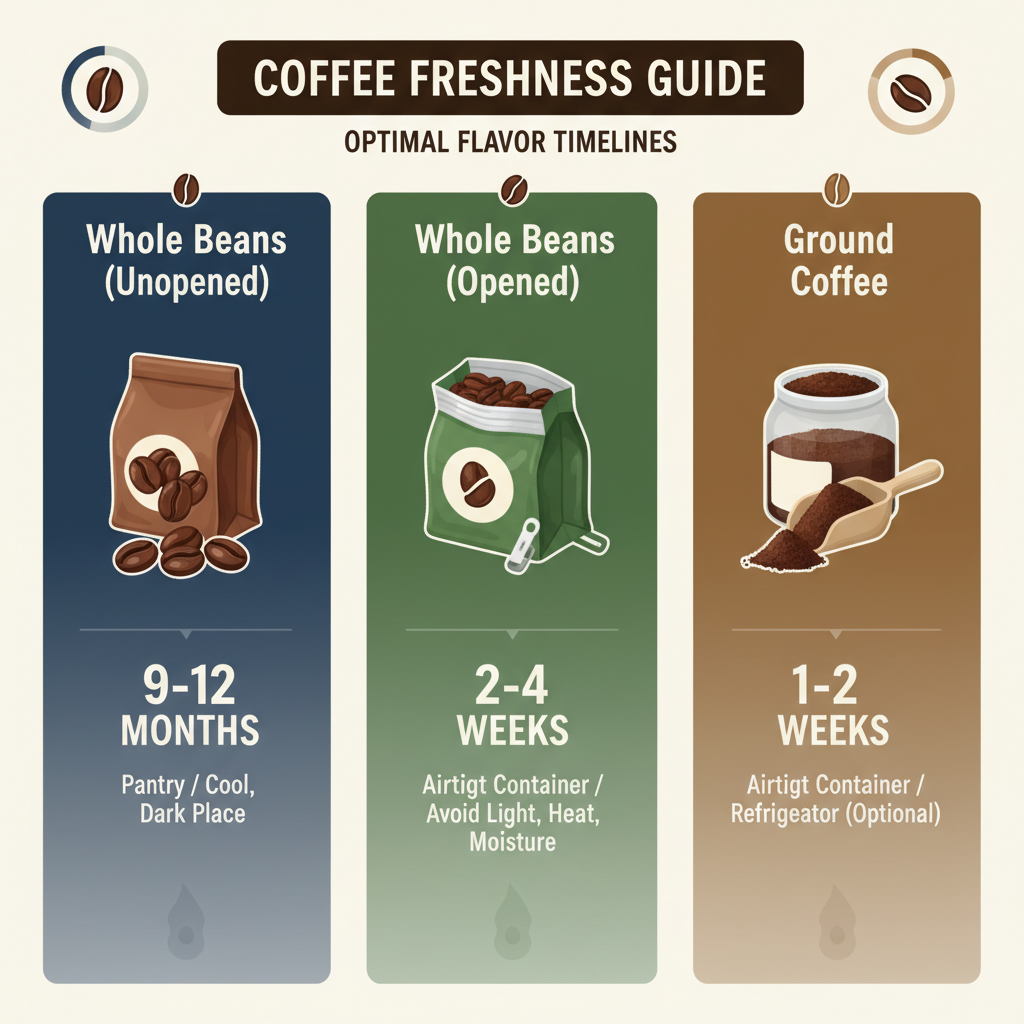
Here’s a general guideline for ‘how long can coffee beans typically last when stored correctly,’ differentiating between various states of coffee:
- Roasted Whole Beans (Unopened, properly stored in original gas-flushed bag):
- Peak Flavor: Generally 2-4 weeks post-roast. This is often when the coffee has fully degassed and developed, offering its most vibrant and complex characteristics.
- Significant Degradation: Up to 3-6 months. While still “drinkable,” the flavor will be noticeably muted, flat, and stale.
- Freezing (unopened, airtight): Can extend quality for 6-12 months or even longer, though some subtle degradation of extremely volatile compounds may still occur over time.
- Roasted Whole Beans (Opened, transferred to an ideal airtight, opaque container, stored cool & dark):
- Peak Flavor: 1-2 weeks. This is your target window for the best possible taste experience.
- Noticeable Staleness: 2-4 weeks. Flavors will be much less distinct, brightness will fade, and bitterness may become more prominent. After this, quality rapidly declines.
- Ground Coffee (Opened, properly stored in an airtight container):
- Peak Flavor: Days to a week. The rapid increase in surface area means a much faster loss of volatile aromatics. It’s truly best consumed within hours of grinding.
- Rapid Degradation: Beyond a week, it becomes noticeably stale and dull very quickly, losing nearly all desirable characteristics.
- Unroasted (Green) Coffee Beans:
- Can last significantly longer (6-12 months or more) under proper cool, dry, dark conditions. This is because the complex chemical reactions of roasting have not yet occurred, making them less prone to rapid oxidation and degradation. They still require protection from moisture and light to prevent mold or premature aging.
Understanding your coffee’s roast date and managing its shelf life is key to consistent flavor. Our comprehensive guide on coffee roasting dates and peak freshness offers more insights into this critical aspect of enjoying your brew.
Frequently Asked Questions
Is it ever okay to store coffee in a clear glass jar?
Yes, but with a major condition: a clear glass jar must always be stored in a completely dark environment, such as a pantry or cabinet, away from any light source. Its transparency makes it highly susceptible to light degradation, which significantly speeds up staling. Additionally, ensure the jar has a tight, truly airtight seal, ideally with a rubber gasket, to protect from oxygen. Opaque containers are always preferred to eliminate light-related concerns entirely.
How do I know if my coffee beans are stale?
You’ll notice several clear signs. First, the aroma will be significantly diminished or simply “flat” when you open the container; fresh beans should have a vibrant, complex fragrance. Second, when you brew, the coffee grounds might not “bloom” (the bubbling and rising when hot water is first added) as vigorously, indicating less CO2. Most tellingly, the taste in your cup will be dull, lack distinctive flavors, and might present as overtly bitter, woody, or even rancid, without the brightness or sweetness you expect.
Can I store ground coffee in the freezer?
While theoretically possible to slow down degradation, it’s generally not recommended for ground coffee. The significantly increased surface area of ground coffee makes it even more susceptible to moisture absorption and odor contamination from the freezer environment. Even in an airtight container, it’s very difficult to prevent these issues entirely, often leading to freezer-burned, flavorless coffee. For the best flavor, stick to freezing whole beans only under strict airtight conditions and grind them fresh once thawed to room temperature.
What’s the biggest mistake people make when storing coffee?
The biggest mistake is either storing coffee in the refrigerator or leaving an opened bag of coffee on the counter. Both expose the beans to fluctuating temperatures, damaging moisture, harmful light, and excessive oxygen, rapidly accelerating the staling process. Failing to transfer opened beans to a truly airtight, opaque container is a common pitfall that dramatically shortens their fresh lifespan and diminishes the quality of their daily brew.
Conclusion: Empower Your Daily Brew
Your journey to a consistently exquisite cup of coffee extends far beyond the brewing method; it begins with how you safeguard your beans. By truly understanding coffee’s enemies—Oxygen, Moisture, Light, and Heat—and rigorously applying the golden rules of storage, you’re not just delaying staleness. You’re actively preserving the intricate flavors, vibrant aromas, and the very essence of your coffee, honoring the roaster’s craft and elevating your entire brewing experience.
This guide provides the definitive knowledge to dispel myths and implement scientifically-backed strategies. Embrace these practices, and you’ll taste an undeniable difference in every sip. Say goodbye to guesswork and stale cups. Empower yourself to enjoy fresher, more flavorful coffee, every single day. Your daily brew deserves this commitment, and the rewards are profound.